What's New in GuardGrid: September 2026
GuardGrid's September update: a new llms.txt generator, a Competitors module with evidence, automatic re-crawling, and a big accuracy pass on the SEO audit.
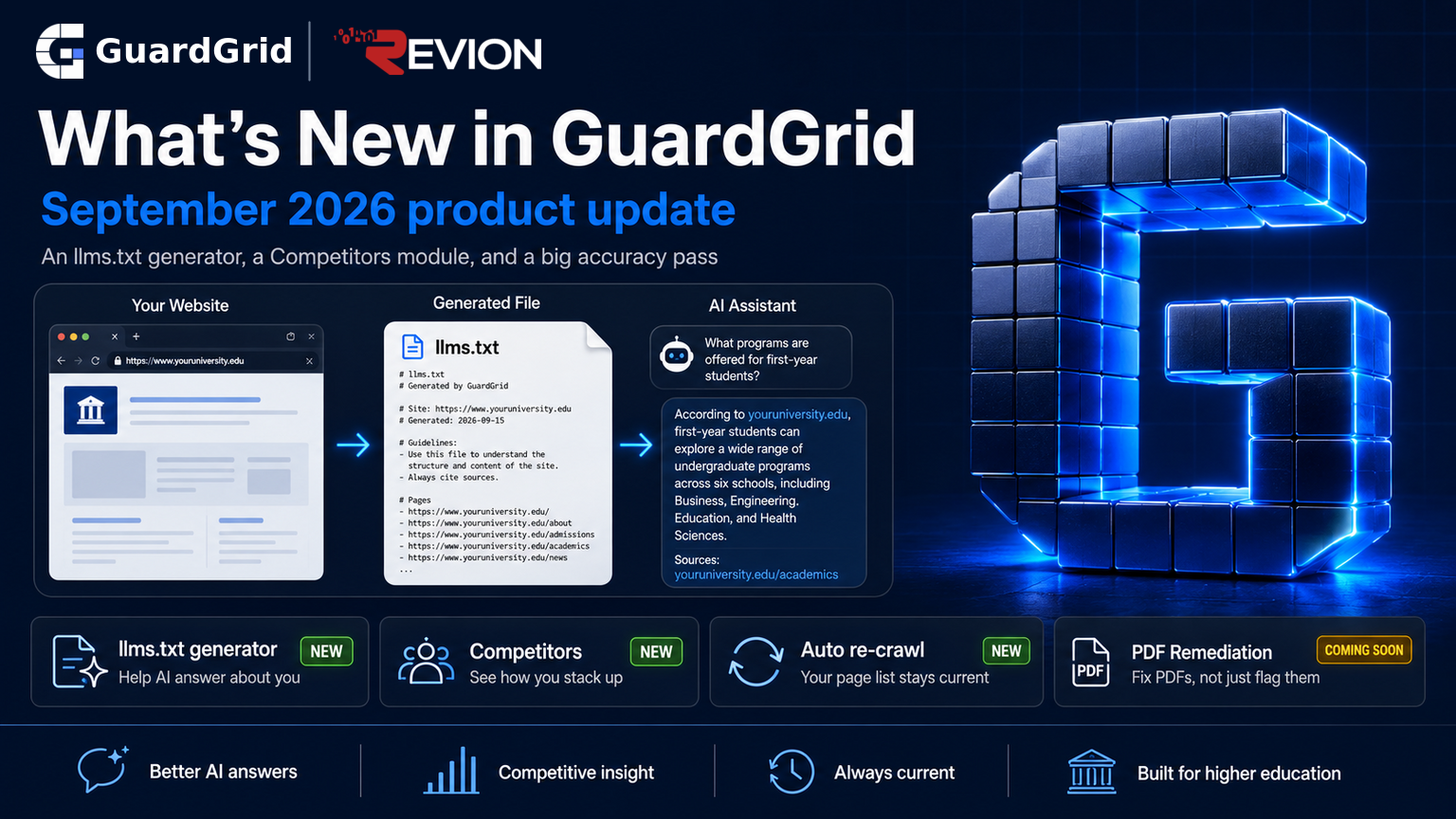
GuardGrid is a web governance platform for higher education, with modules for accessibility, SEO, privacy, brand and AI visibility, and more. This is our regular product update. Since the August digest, the headline additions are an llms.txt generator and a new Competitors module, alongside automatic re-crawling and a big accuracy pass on the SEO audit. Everything below is already in your account.
llms.txt generator
More of your prospective students start with an AI assistant, not a search box. An llms.txt file is a simple text summary of your site, published at your domain, that gives those models a clean description of your institution instead of leaving them to parse raw HTML.

GuardGrid now generates that file for you, in a new llms.txt tab under AI Readiness. It builds from your own page titles, meta descriptions, and internal links, ranks the most-linked pages first, and leaves out noindex pages and pages with no readable text. GuardGrid never invents a description for a page, it uses yours. Download or copy the file and place it at your site root. The tab also confirms the file is well formed, and where you already publish an llms.txt, it shows you the difference between yours and what GuardGrid would generate. This pairs naturally with the AI Visibility work from August: give the models something clean to read, then measure how they describe you.
Competitors: see exactly how you stack up
The new Competitors tab leads with three scorecards, SEO, Performance, and Privacy and Security, each labeled Ahead, Behind, or Comparable. There is no single blended score to hide behind. Click any score and a panel opens the evidence: the page it was measured on, the exact finding, what the competitor does instead, and the specific change to make.
A “What to fix first” worklist ranks those changes, putting items that several competitors share at the top, so you work on what moves the needle. The Privacy and Security comparison reads ten signals from each homepage, https redirect, HSTS, Content Security Policy, clickjacking and MIME-sniffing protection, Referrer-Policy, insecure content, a cookie consent banner, high-risk trackers, and a linked privacy policy, all from what a site already publishes openly. A competitor that has not been audited yet shows as pending and never counts for or against you.
Automatic re-crawl and a cleaner inventory
Your page list now keeps itself current. Every property is re-crawled on a schedule, weekly by default, with bi-weekly, monthly, or off available per property, and runs are staggered across the week. Anything reachable from your homepage or listed in your sitemap joins the inventory on the next crawl, with no action from you, and “Re-crawl now” runs one immediately.
Inventory also gained a Removed view: pages that start returning 404 or 410 are listed with the detection date, the reason, and whether any live page still links to them. GuardGrid checks that a page truly is gone before untracking it, keeps pages that merely time out or drop from the sitemap, and if a re-crawl would remove more than ten pages, it asks you to confirm first.
Weekly and daily scan summaries
Scan summaries can now go out weekly, the default, sent every Monday for the prior week, or daily, as one summary per account rather than a message per page. Each summary names each site, how many pages need attention, and which rules changed, and it counts pages that recovered, not just ones that regressed. Recipients come from your team membership automatically, and anyone can turn their own off.
A big accuracy pass on the SEO audit
Most of this cycle went into making the numbers you rely on more trustworthy, a broad accuracy pass across the SEO audit.

Image alternative-text findings now come from a single source shared with your WCAG results, and correctly-marked decorative images are no longer penalized. Sitemaps behind a redirect are found, including on a common WordPress SEO plugin. An unreachable site now reports exactly why, an expired or wrong certificate, a refused connection, a bot block, a timeout, in plain language, and is marked unmeasurable rather than scored as a failure. Measurements the host controls, like compression, HTTP protocol, and HTML document size, are now reported rather than scored. PDF checks improved too: the PDFs tab reports whether a document is tagged, declares a language, and carries bookmarks, and labels encrypted or unreadable PDFs honestly so the figures add up. Several of these move scores slightly, always as a correction to what was measured, never a change to how strictly your site is graded.
Coming soon: PDF remediation
The question we hear most is about PDFs, so here is a straight answer. Today GuardGrid checks them: the PDFs tab flags whether each document is tagged, declares a language, carries bookmarks, and how much of it a screen reader can actually read. Remediation, actually correcting those problems, starting with tags and reading order, is in development and shipping soon.

On the roadmap
A few more things we are building next: suggested fixes that offer a correction alongside today’s guidance; tamper-evident compliance evidence with hash-stamping and protected storage; team roles and an activity log; and single sign-on for organizations.
One platform for accessibility, SEO, and web governance
GuardGrid brings accessibility, SEO, privacy, brand and AI visibility, and security into one web governance platform, so a higher-education team can manage its whole web presence in one place. It scans your entire site, not one page, grades it against WCAG 2.1 AA and WCAG 2.2, and produces audit-ready compliance reports, with the ADA Title II deadlines in mind.
See it in your account
GuardGrid customers can use all of this now. Log in to see it in your account. Not using GuardGrid yet? Run a free ADA and WCAG scan, explore the platform, or compare plans. Questions about any of this? Get in touch.